For a long time, the assumption in aged care was simple. People get older, they need more support, they move into a facility. That was the natural order of things. Hospitals and residential aged care were where the serious work of caring for older Australians happened.
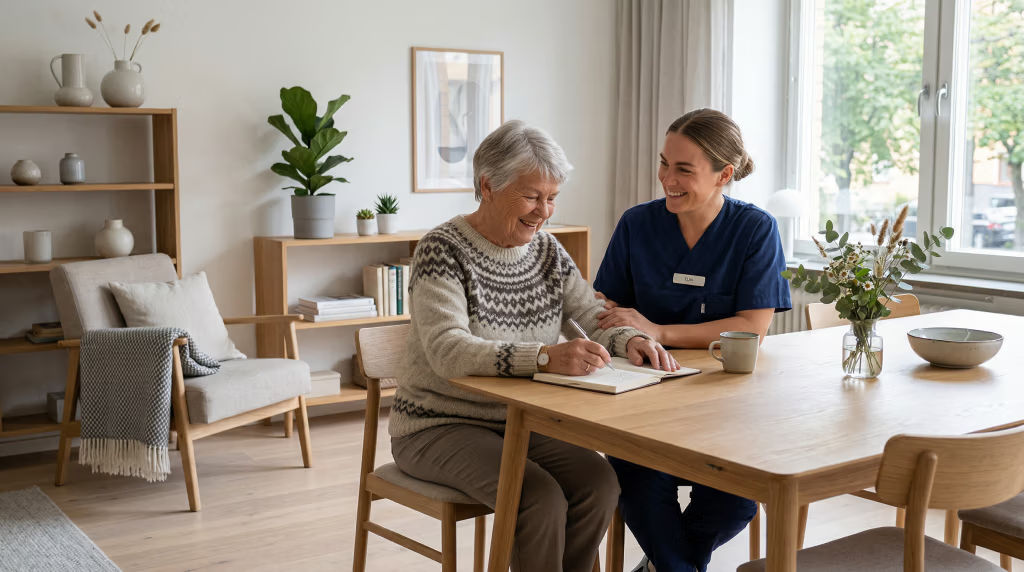
That assumption is being dismantled in real time by something much more powerful than policy: the actual choices older Australians are making about where they want to live and receive care. Seven in ten older Australians say they want to age at home. Not in a facility. Not in a hospital. At home, in the environment they know, with the routines they have built over a lifetime. That preference is not new. What is new is that government policy, funding, and technology have finally started to align with it.
The numbers that follow are not projections. They are things that have already happened.
The growth has been extraordinary
In 2017, around 71,900 Australians were receiving government-funded home care. By 2024, that number had grown to 275,000 — a 283% increase in seven years. The rate of usage per 1,000 older Australians more than tripled, from 18 to 58 per 1,000 population. Gen-agedcaredata
Over that same period, the number of people in permanent residential aged care grew by 6.3%. Australian Institute of Health and Welfare Read those two numbers together. Home care grew 283%. Residential aged care grew 6.3%. The direction of travel in Australian aged care is not ambiguous.
By early 2025, more than 289,000 older Australians were receiving Home Care Packages. The Australian aged care market is projected to reach USD 61.3 billion by 2034. Vocal Media
Why older Australians prefer home care
People in familiar environments do better. This is particularly pronounced in dementia care, where routine, memory cues, and a known physical environment reduce confusion and anxiety in ways that even well-designed facilities often struggle to match. The layout of a person’s kitchen, the sound of their backyard, the particular chair they have sat in for thirty years — these things are part of how the brain of someone with cognitive decline navigates the world.
Home care also enables early intervention in a way that institutional care does not. A worker visiting a client three times a week notices things. They notice when someone is not eating. Changes in mood, mobility, or cognition. When someone is becoming socially isolated. These are the signals that, caught early, prevent hospital admissions. Good home care catches these things before they become crises.
And families need this too. The caregiver burden in Australia is substantial and often invisible. Adult children managing the care needs of an ageing parent while also working and raising their own families are navigating enormous complexity. Home care, when it works well, provides not just support for the older person but relief and coordination for the whole family system around them.
The government has made its position clear
The launch of the Support at Home program in November 2025 replaced the Home Care Packages Program and the Short-Term Restorative Care Programme. Australian Government Department of Health It introduced eight funding classification levels, with a stronger emphasis on early intervention and a new end-of-life pathway specifically designed to help people remain at home in their final months. By 2027, the Commonwealth Home Support Programme will also transition into Support at Home, bringing the entire in-home care system under one unified framework.
The 2024-25 Federal Budget committed $2.2 billion to the aged care sector, with an additional 24,100 Home Care Packages added to the system totalling $531.4 million. The CareSide
By 2035, an estimated 1.4 million Australians will require in-home support. Focusconnect The government is building infrastructure for that reality right now.
But demand is still outstripping supply
The honest version of this story includes a difficult truth. Despite all the growth in home care, demand is still not being met. As of late 2025, more than 88,000 people were approved for government-funded home care but not yet receiving it. Another 120,000 were waiting just to be assessed. The combined backlog exceeded 200,000 Australians waiting for in-home help. Aged Care Guide
This is not an argument against home care as the future of healthcare. It is an argument for better systems within home care. For the kind of operational infrastructure that allows providers to scale without losing quality, manage more complex clients, and demonstrate outcomes to funders and regulators.
Home care is not easy. Anyone who suggests it is simply cheaper or less complex than residential care has not actually worked in it. It requires coordination across dispersed workforces, real-time information about what is happening in clients’ homes, and accountability systems that work without the physical structure of a facility to contain them. Without strong systems, it fragments quickly.
What this means for home care providers right now
The Support at Home reforms have introduced quality indicator requirements for home care providers for the first time. Residential aged care providers have been reporting quality indicators through the NQIP program for years. Home care is now following the same path, with quality indicators expected to come into effect in 2026.
This changes the data demands on home care providers substantially. Consumer experience, service quality, and clinical outcomes will need to be measured, tracked, and reported. Providers who are already collecting this data systematically will be in a much stronger position than those who are not.
The home care provider landscape continues to fragment as more providers enter the sector, with 873 providers operating nationally by FY25. As KPMG notes, the providers who continue to grow are those able to offer a standout service experience, maintain high quality, and manage rising costs — a combination that is increasingly difficult to achieve without the right systems and support in place. KPMG
The shift from reactive to proactive
What home care represents, at its best, is a fundamental shift in how healthcare works. Not reactive treatment of illness and decline after it has already occurred. Proactive support that maintains function, preserves independence, and catches problems early.
This is better for the people receiving care. Better for the healthcare system overall. And significantly better for the experience of ageing itself, which for most older Australians does not need a hospital bed. It needs consistency, trust, and time. It needs someone who knows them well enough to notice when something is different.
The future of healthcare in Australia is not more beds. The data makes that clear. It is better support, delivered where people already live, by workers and systems capable of providing that support at scale. The providers who understand that shift and build their operations around it are the ones who will be well positioned as the sector continues its transformation.
Book a demo to see how Carepage supports home care providers preparing for quality indicator requirements and the new Support at Home compliance framework.