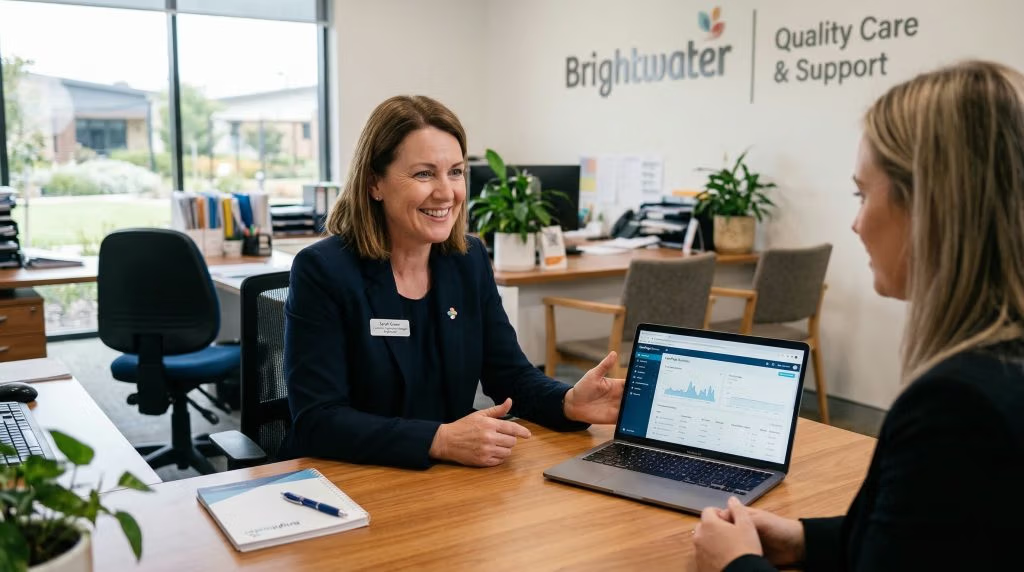

For the past several years, most residential aged care providers in Australia have managed their National Quality Indicator Program obligations the same way — manually. Paper assessments. Spreadsheets. Someone spending days every quarter collating data before the 21st of the month deadline.
That approach is under pressure. The QI Program now covers fourteen indicators, includes consumer experience and quality of life surveys, and sits inside a regulatory framework that expects providers to demonstrate they are using the data, not just submitting it. Manual processes that were functional at three indicators are struggling at fourteen and the program is not staying in residential care.
From no earlier than 1 July 2026, home care providers operating under the Support at Home program will face their own mandatory quality indicator requirements. The infrastructure question that residential providers have been wrestling with for years is now arriving for home care as well. The shift to automated NQIP reporting is already underway in residential aged care. For home care, it is what comes next.
What is driving the shift in residential aged care
The QI Program has expanded significantly since it launched in 2019 with three clinical indicators. The addition of consumer experience and quality of life surveys in 2023 introduced a survey coordination requirement that is genuinely difficult to manage manually at scale. The addition of three staffing indicators in April 2025 added another data stream requiring reconciliation with the Quarterly Financial Report.
Each expansion has added complexity to a process that was already time-consuming. More indicators means more assessments, more surveys, more data to collate, more opportunity for error, and more pressure on the people responsible for getting it done on time.
At the same time, the regulatory expectation has lifted. The Aged Care Act 2024 and the strengthened Quality Standards that came into effect in November 2025 place providers under an obligation not just to collect and submit data but to show it is informing continuous improvement. A provider that submits accurate data every quarter but cannot demonstrate what they did with it is no longer fully meeting the intent of the program.
That combination — more data to manage, higher expectations for how it is used — is what is making automated reporting the direction the residential sector is already moving.
What automated NQIP reporting actually means
Automation describes a category of approaches where software handles the parts of the QI reporting process that do not require clinical judgement — the scheduling, delivery, collation, and formatting.
For survey-based indicators — consumer experience and quality of life — automation means residents or clients receive their surveys on a set schedule without a staff member needing to initiate each one. Responses are collected electronically and aggregated automatically. By the time the quarter closes, the data is already compiled rather than still sitting in paper form waiting to be counted and entered.
For clinical indicators such as pressure injuries, falls, and physical restraint, automation means assessments are recorded digitally at the point of care rather than on paper that gets transcribed later. The record exists from the moment it is made.
At the submission end, automation means the system generates a report in the format required by the Government Provider Management System rather than requiring someone to build it from a spreadsheet. The 21st of the month deadline becomes a date on which someone reviews and submits, not a deadline that requires days of preparation beforehand.
For a detailed breakdown of how automated NQIP reporting works across different indicator types, the mechanics cover both the survey-based and clinical components of the program.
What is coming for home care
The home care QI program is confirmed. The government has set a start date of no earlier than 1 July 2026 for providers under the Support at Home program, giving the sector a window to prepare but not an indefinite one.
The program will initially cover a focused set of indicators. Consumer experience and quality of life are confirmed as the priority areas, consistent with the government’s emphasis on person-centred care under the new Aged Care Act. Further indicators are expected to be added over time, following the same step-by-step approach used to expand the residential program.
For home care providers, the data collection challenge is operationally different from residential care. Clients are dispersed across individual homes. Staff are mobile, delivering services at different times to different people. There is no single physical location where data collection happens naturally. A residential provider can coordinate a quarterly survey round with residents in the same building. A home care provider is coordinating surveys across dozens or hundreds of separate households.
That reality makes manual data collection for home care quality indicators particularly difficult to sustain. The providers who build automated survey delivery and response tracking infrastructure before the requirement starts will find the transition considerably smoother than those who try to manage it manually from the outset.
The home care quality indicator program and what is confirmed for July 2026 covers the proposed framework, the consultation outcomes, and what is currently known about the indicators and submission requirements.
What providers in both settings are doing now
The residential providers who have moved to automated reporting describe the change in consistent terms. The quarterly deadline stops being a crisis and becomes routine. The quality manager who was spending two or three days every quarter on data entry starts spending that time on what the data actually shows.
That shift matters. Quality managers and directors of nursing are not hired to do data entry. They are hired to improve care. When the administrative load of manual reporting consumes their time every quarter, the analysis and improvement work the QI Program is designed to drive does not happen at the level it should.
For home care managers facing the same requirement from July 2026, this is the experience waiting on the other side of building the right infrastructure now rather than later.
Automated reporting does not remove clinical or care judgement from the process. It removes the data handling that sits around that judgement and takes up time that would be better spent elsewhere.
What to consider when evaluating options
For providers in either setting starting to look at automated reporting tools, a few things are worth considering.
The first is whether the tool covers all the indicator types relevant to your service — both survey-based and clinical for residential, survey-based for home care initially. Partial automation still leaves meaningful administrative burden.
The second is how submission works. A tool that collects data well but still requires manual formatting before submission is better than nothing but is not the same as a system that generates a submission-ready report.
The third is what happens with the data after submission. Under the strengthened standards, providers need to demonstrate the data is informing improvement. A tool that archives submissions without providing trend analysis or benchmarking does not fully support that obligation.
The fourth, relevant for providers operating across both residential and home care, is whether the system handles both settings from a single platform — or whether you are managing two separate systems for two sets of reporting obligations.
How Carepage supports NQIP reporting across both settings
Carepage’s platform covers NQIP data collection and reporting for residential aged care providers today, including automated delivery and response tracking for consumer experience and quality of life surveys, digital collection for clinical indicator data, and generation of submission-ready reports aligned to the current QI Program requirements.
For providers preparing for the home care QI extension coming no earlier than July 2026, the same infrastructure extends to in-home care clients as the program develops. Providers operating across residential and home care settings can manage both within the same platform rather than running separate reporting processes for each.
Book a demo to see Carepage’s NQIP reporting tools in action.