
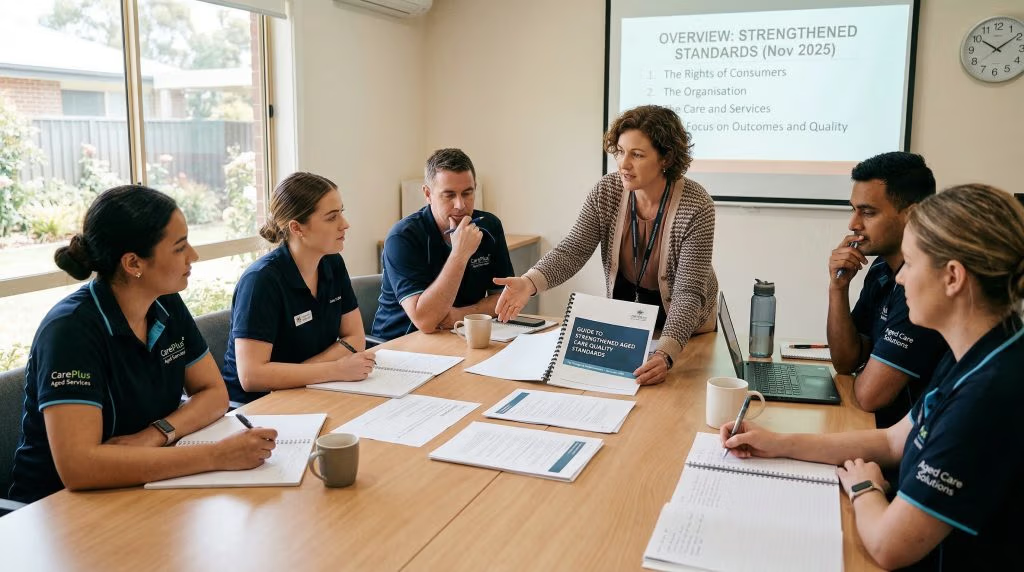
On 1 November 2025, the aged care sector in Australia moved to a new set of Quality Standards. If you have been in the sector for any length of time, you will have lived through the previous eight standards that were in place since 2019. Those are now gon. What replaced them is a set of seven strengthened standards — more detailed, more measurable, and built around a fundamentally different premise. The old standards told providers what to do. The new ones tell providers what to prove.
That shift matters enormously for how quality and compliance work inside aged care organisations. It affects what you collect, what you document, what you can show the Commission, and ultimately whether your accreditation holds. This is what changed, standard by standard, and what it means in practice.
Why the standards were strengthened
The Royal Commission into Aged Care Quality and Safety was explicit about the problem with the previous standards. They were too broad. Too easy to technically comply with while delivering poor care. Too difficult to measure in any meaningful way. The Commission recommended an urgent review.
The result, after years of consultation, is a framework built around person-centred outcomes rather than process compliance. The question a surveyor is now asking is not just whether a policy exists — it is whether the policy is working, whether older people are experiencing the care it describes, and whether the provider can demonstrate that.
This is a meaningful change in how compliance is assessed. Having a complaints policy is not enough. The Commission wants to see that complaints are being received, acknowledged, investigated, and closed in a way that improves care.
From eight standards to seven
The previous framework had eight standards covering consumer dignity and choice, assessment and planning, personal and clinical care, daily living services, the service environment, feedback and complaints, human resources, and organisational governance.
The strengthened framework consolidates and reorders these into seven standards with different names and significantly expanded expectations. Clinical care and food and nutrition now stand alone as dedicated standards — reflecting the Royal Commission’s findings about how frequently both areas were failing residents.
Here is the full picture of what each standard covers and what changed.
Standard 1 — The individual
This is the foundational standard and it underpins everything else. It is about how providers and workers treat older people at every interaction — recognising their identity, respecting their diversity, upholding their rights under the Statement of Rights, and supporting them to make decisions about their own care and life.
What changed significantly here is the Statement of Rights. Under the Aged Care Act 2024, older people now have legislated rights that providers are required to actively uphold — not just acknowledge. This includes the right to be free from abuse and neglect, the right to receive quality care and services, and the right to be treated with dignity and respect in a way that recognises their identity and culture.
Providers need to demonstrate that staff at every level understand these rights and that the organisation’s practices reflect them. It is not a policy exercise — it is a culture and evidence exercise.
Standard 2 — The organisation
This standard addresses governance, leadership, and workforce. The governing body — your board or executive leadership — is now directly accountable for setting strategic priorities around quality and safety, and for creating a culture that supports continuous improvement.
The shift from the previous Standard 8 (organisational governance) is significant. The new standard is more explicit that the governing body must be actively engaged with quality and safety data, not just receiving reports. It must demonstrate that it is using quality indicator data, complaint trends, incident reports, and consumer feedback to inform strategic decisions.
This is where platforms that provide real-time dashboards and trend analysis become directly relevant to governance accountability — because the Commission can now ask the board what the data showed and what they did about it.
Standard 3 — The care and services
This standard covers the way providers tailor care and services to each person — from initial assessment and care planning through to service delivery and review. It applies across residential care, home care, and retirement living.
What changed most noticeably here is the emphasis on individualisation. Care plans must genuinely reflect the individual’s goals, preferences, and circumstances — not be template documents with names inserted. The assessment process must involve the older person and, where relevant, their supporters.
For home care providers specifically, this standard now applies with the same rigour as residential care. Assessment, planning, and service delivery must be documented and demonstrably personalised.
Standard 4 — The environment
This standard is about the physical and social environment in which care is delivered. Spaces must be safe, accessible, comfortable, and supportive of residents’ wellbeing. For home care, it extends to ensuring the home environment is assessed for safety and that risks are managed.
One addition worth noting is the explicit requirement for workers to have the right skills and knowledge to do their jobs. Training and competency is now formally embedded in this standard — making workforce development a compliance matter, not just a good practice aspiration.
Standard 5 — Clinical care
Clinical care now has its own dedicated standard, which it did not have in the previous framework where it sat alongside personal care in Standard 3. This reflects how central clinical quality is to resident safety and how consistently it featured in Royal Commission findings.
The standard covers the full range of clinical care — medication management, wound care, falls prevention, pain management, palliative care, and infection control. Each area must be delivered safely and in line with evidence-based practice.
For providers, the clinical care standard creates a clear evidence obligation. It is not enough to say that clinical care is delivered according to policy. The NQIP quality indicators — pressure injuries, falls, physical restraint, unplanned weight loss, medication management — are now explicitly the measurement layer that sits underneath this standard. Your QI data is your evidence.
This is the most direct link between the NQIP reporting program and the strengthened standards. Understanding how NQIP reporting works is not just a compliance administration question — it is a Standard 5 question.
Standard 6 — Food and nutrition
Food and nutrition is the other area to receive its own dedicated standard. The Royal Commission found that meal quality, hydration, and the dining experience were consistently among the most common sources of resident dissatisfaction and one of the most visible indicators of care quality.
The standard requires that food is nutritious, varied, and meets individual preferences and dietary needs. It also covers the social and sensory experience of dining — not just whether meals meet nutritional targets. Residents must have genuine choice about what, how much, and when they eat.
For providers, this means food and nutrition monitoring needs to be embedded in care planning and regularly reviewed. Unplanned weight loss — one of the NQIP quality indicators — sits directly under this standard as a measurable outcome.
Standard 7 — Feedback and complaints management
The final standard covers how providers receive, acknowledge, investigate, and respond to feedback and complaints. It applies across all care settings and all forms of feedback — formal complaints, informal concerns, compliments, and suggestions.
What changed most significantly here compared to the previous Standard 6 is the expectation around proactive feedback seeking. Providers are expected not just to have a complaints process but to actively create an environment where older people and their families feel safe and supported to provide feedback. That means asking for feedback regularly, making it easy to give, and demonstrating that it leads to change.
It also means safe disclosure. Under the new Act, whistleblowing protections have been strengthened and providers must have mechanisms in place that allow staff, residents, and families to raise concerns without fear of reprisal.
For providers using feedback and complaints management software, this standard is where the investment is most directly evidenced. The ability to show a surveyor — or a board — a complete picture of feedback received, how it was handled, and what changed as a result is no longer a nice-to-have. It is the standard.
What the Commission is looking for
The shift from the old standards to the new ones is essentially a shift from policy compliance to outcome evidence. The Commission’s auditors are not just checking whether policies exist. They are asking providers to demonstrate that those policies are producing the outcomes they describe.
In practical terms, this means providers need to be able to produce evidence across several dimensions for each standard: that systems and processes are in place, that staff understand and follow them, that older people are experiencing the care those systems are designed to deliver, and that the organisation reviews and improves when gaps are identified.
Feedback data, quality indicator results, complaint trends, incident records, and consumer experience surveys are all forms of evidence the Commission can draw on. Providers who have been collecting this data systematically are in a far stronger position than those who are pulling it together at audit time.
How Carepage supports the strengthened standards
Carepage’s platform is designed around exactly this evidence requirement. Resident and family feedback collected through Carepage provides direct evidence for Standards 1, 3, and 7. Quality indicator data collected and reported through the platform evidences Standards 2 and 5. Complaints management through Carepage creates the audit trail Standard 7 requires. Safe disclosure tools support the whistleblowing expectations embedded across the framework.
For providers who want to generate audit-ready reports aligned to the strengthened standards, the platform supports reporting across all seven standards rather than requiring data to be assembled from multiple systems.
Book a demo to see how Carepage evidences the strengthened Aged Care Quality Standards.