
If you work in residential aged care in Australia, the National Quality Indicator Program is not optional, not new, and not going away. Every quarter, without exception, your home must collect data across fourteen quality indicators and submit it to the government.
Most providers know this. What is less well understood is how the program works in its current form, what has changed under the new Aged Care Act, where the home care extension is heading, and what separates providers who manage reporting smoothly from those who scramble every quarter. This is the complete picture.
What is NQIP?
The National Quality Indicator Program, the NQIP or QI Program, is a mandatory quarterly reporting requirement for all Australian Government-funded residential aged care homes. It has been compulsory since 1 July 2019, when it launched with three indicators. It now covers fourteen.
The purpose of the program is to measure aspects of care quality that affect the health, safety, and wellbeing of residents, and to make that data publicly available. The Australian Institute of Health and Welfare publishes results quarterly at a national level, and the data feeds into how the sector is monitored, regulated, and funded.
For providers, the QI Program is both a compliance obligation and a performance lens. The data you submit does not sit in a folder somewhere — it is published, benchmarked, and increasingly scrutinised.
The fourteen quality indicators
The program expanded to fourteen indicators on 1 April 2025, following the addition of three staffing indicators to the original eleven. The current indicators cover the following areas.
In clinical care, providers report on pressure injuries, physical restraint and restrictive practices, unplanned weight loss, falls and major injury, and medication management.
In consumer experience and quality of life, providers collect and report on resident experience through structured surveys measuring whether residents feel respected, heard, and well cared for, and quality of life surveys assessing whether residents feel their life at the home is meaningful and connected.
In staffing, providers now report on enrolled nurse hours, allied health professional hours, and lifestyle officer hours — the three indicators added in April 2025. Four of the five data points for these indicators come from the Quarterly Financial Report, reducing the additional burden on providers, but they require accurate staffing records to be maintained throughout the quarter.
How reporting works
Data is collected across the full quarter. For clinical indicators, this means assessments conducted on or around the same time each quarter for all eligible residents. For consumer experience and quality of life, it means surveys delivered and collected within the quarter. For staffing indicators, it means drawing on data already captured in the Quarterly Financial Report.
Once the quarter closes, providers have until the 21st of the following month to submit their data through the Government Provider Management System. Missing this deadline creates a compliance issue and gaps in the national dataset.
If a commercial benchmarking company submits data on a provider’s behalf, the provider remains responsible for the accuracy and timeliness of that submission. The obligation does not transfer.
The AIHW publishes results at national, state, territory, and remoteness levels for each quarter. Providers can benchmark their performance against national averages — and the Commission can use that data when assessing provider performance.
What changed under the Aged Care Act 2024
The Aged Care Act 2024 came into effect on 1 November 2025 alongside the strengthened Aged Care Quality Standards. The QI Program continues under this new framework, but the expectations around how providers use the data have shifted.
Previously, the obligation was essentially to collect and submit. Under the strengthened standards, providers are expected to demonstrate that quality indicator data is informing their practice. That means discussing trends at a governance level, identifying where performance is declining, acting on those gaps, and being able to show that the data is feeding into a genuine continuous improvement cycle — not just being submitted and forgotten.
The Commission can ask to see evidence of this during audits and accreditation visits. A provider that submits clean data every quarter but cannot show what they did with it is no longer fully meeting the intent of the program.
This shift makes the infrastructure around data collection and analysis more important than it was before. Submitting is the floor, not the ceiling.
The consumer experience and quality of life indicators
Of all the indicators in the program, the consumer experience and quality of life measures are the ones most directly tied to how residents feel about their daily life — and they are increasingly central to how regulators, families, and accreditation bodies assess a provider.
Consumer experience surveys ask residents about their interactions with staff and the service overall. Questions cover whether staff treat residents with respect, whether residents feel listened to, and whether they feel safe. Quality of life surveys cover whether residents feel their life has meaning, whether they have choice and control, and whether they feel connected to people and activities that matter to them.
Both sets of surveys must be offered to all eligible residents each quarter. Residents can decline, and those who lack capacity may have a representative respond on their behalf. The response rate and the scores both form part of the submitted data.
For providers using Carepage’s automated resident survey tools, survey delivery, reminders, response tracking, and report generation happen within the platform — removing the manual coordination that makes these indicators administratively heavy when managed by hand.
The staffing indicators
The three staffing indicators introduced in April 2025 — enrolled nurses, allied health professionals, and lifestyle officers — reflect the government’s focus on workforce composition as a quality measure.
The rationale is straightforward. These roles contribute directly to resident wellbeing. Enrolled nurses provide clinical care that supplements registered nurse hours. Allied health professionals support physical function, mental health, and independence. Lifestyle officers run the programs that keep residents connected, engaged, and purposeful.
Tracking these hours through the QI Program creates a national picture of whether providers are investing in these roles, and how that investment correlates with resident outcomes. For providers, it means staffing data needs to be consistently recorded and reconcilable with what is submitted through the Quarterly Financial Report.
Pressure injuries, falls, and physical restraint
The clinical indicators — pressure injuries, falls, physical restraint, and unplanned weight loss — are the original core of the QI Program and remain the most clinically significant.
Pressure injuries are assessed for all eligible residents on or around the same day each quarter, using the ICD-10-AM classification system across six stages. Falls are recorded when a resident falls during the quarter and whether the fall results in a major injury. Physical restraint is captured across three days of records per quarter, covering all forms of restrictive practice excluding chemical restraint.
Unplanned weight loss covers residents who have lost more than five percent of their body weight in one month, or more than ten percent over six months, where that loss was not clinically planned.
Accuracy in these indicators matters. They are published nationally and used in benchmarking. Providers with persistently high rates of pressure injuries or physical restraint attract regulatory attention. Providers with consistently low rates demonstrate clinical quality that families and prospective residents can see.
Manual versus automated reporting
How a provider manages the logistics of NQIP data collection and submission has a significant effect on the administrative burden involved and the accuracy of the data produced.
Manual processes like paper assessments, spreadsheet compilation, manual portal entry are functional but vulnerable. Assessments get missed. Data gets transcribed incorrectly. The person responsible for compiling the submission changes and institutional knowledge walks out the door with them. Quarterly deadlines create a recurring crunch.
Automated approaches use software to handle collection scheduling, response tracking, data aggregation, and report generation. For survey-based indicators, this means residents receive surveys on a schedule without requiring staff to coordinate each one manually. For clinical indicators, it means digital forms that feed directly into a central record rather than paper that needs to be transcribed. At submission time, it means a report that is ready to go rather than something that still needs to be built.
For providers who want to understand what automated NQIP reporting actually means in practice, the mechanics are straightforward — but the operational difference between manual and automated is significant, particularly for larger homes and multi-site operators.
The home care extension
The QI Program currently applies to residential aged care only. That is changing.
The government has confirmed that quality indicators will be introduced for home care providers operating under the Support at Home program, with a start date no earlier than 1 July 2026. The program will initially cover a focused set of indicators — consumer experience and quality of life are confirmed — with further indicators expected to follow over time.
Home care providers who have not yet started thinking about quality indicator data collection are in the same position residential providers were in 2018. The requirement is coming. The providers who build the measurement infrastructure before the deadline rather than after will find the transition considerably less disruptive.
For a detailed breakdown of what the home care QI program will cover and what is currently confirmed, the home care quality indicators article covers the proposed framework, the consultation outcomes, and the July 2026 timeline in full.
Using NQIP data beyond compliance
The QI Program was designed as an accountability and transparency mechanism. It works best for providers when it also functions as an operational tool.
Providers who treat QI data as a compliance obligation to be managed tend to submit their numbers and move on. Providers who treat it as a performance signal tend to use it differently — looking at trends across quarters, identifying which residents or wards are driving particular indicators, correlating quality of life scores with staffing patterns, and building it into their continuous improvement planning.
This is now what the strengthened standards expect. But beyond compliance, it is also just more useful. A provider who knows that their pressure injury rates have been trending upward for two quarters, and can trace that to a change in wound care practices or a shift in resident acuity, is in a fundamentally better position than one who submits the data without knowing what it says.
The data is already being collected. What happens with it is the question that separates good governance from box-ticking.
What Carepage covers
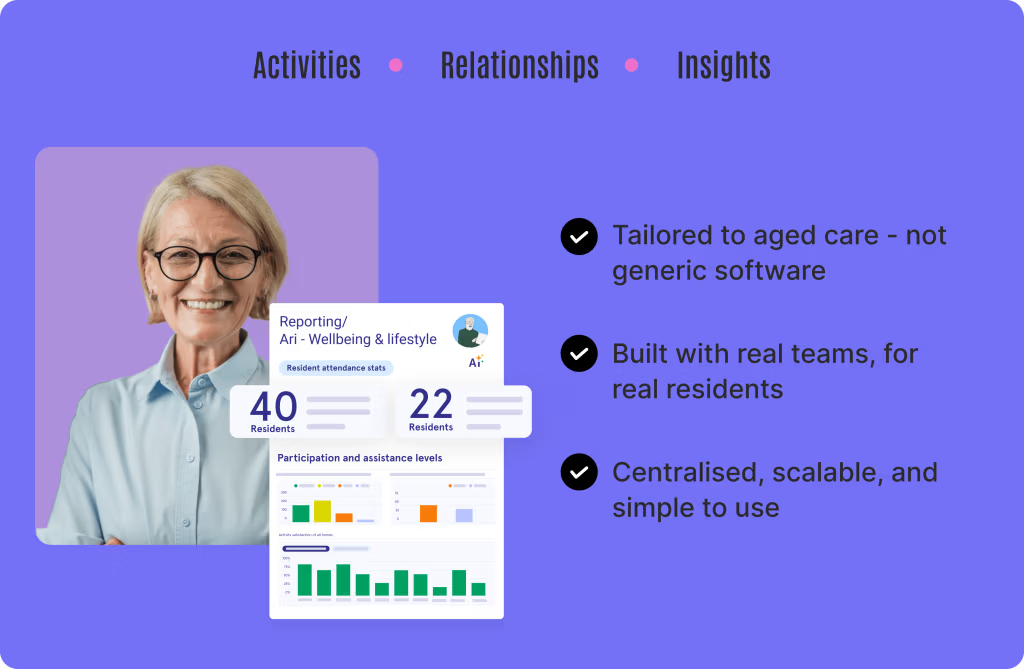
Carepage’s platform supports NQIP data collection and reporting across both the survey-based and clinical indicator areas. Providers can manage consumer experience and quality of life surveys with automated delivery and response tracking, generate submission-ready reports aligned to the current QI Program requirements, and maintain a continuous record of indicator trends across quarters.
For multi-site operators, the platform provides visibility across all homes rather than requiring data to be pulled together from separate systems. For homes preparing for the home care QI extension, the same infrastructure that supports residential reporting can be extended to cover in-home clients as the program develops.
Book a demo to see Carepage’s NQIP reporting tools in action.