
The Higher Everyday Living Fee is now live across Australian residential aged care, and providers are realising quickly that spreadsheets and paper-based systems won’t hold up under scrutiny. The demand for HELF management software has followed almost immediately.
The problem is that not every tool marketed for HELF actually does what providers need. Some are lifestyle scheduling tools with HELF packaging bolted on. Others focus purely on billing. Very few connect HELF program delivery to the broader compliance picture that ACQSC now expects.
This article breaks down what genuine HELF management software needs to do, the questions to ask before committing to a platform, and why the providers getting the most out of their HELF programs are treating it as a compliance and experience function rather than an add-on.
What HELF actually requires from a software perspective
HELF replaced extra service fees and additional service fees on 1 November 2025. Under the new Aged Care Act 2024, providers can charge an optional fee for a defined set of higher quality everyday living services across areas like dining, lifestyle, concierge, and communication.
The compliance requirements that sit behind HELF are what make software non-negotiable. According to ACQSC guidance, providers must:
- Maintain a written agreement with each resident who opts into HELF
- Clearly define which services are included and at what standard
- Deliver those services consistently and be able to demonstrate that delivery
- Not charge for services that were not provided or did not meet the agreed standard
- Make it easy for residents to opt in, change, or opt out
That last point matters more than most providers realise. HELF is voluntary. Residents and families can withdraw at any time. Software that makes opt-out difficult or obscures what was and wasn’t delivered is a compliance risk, not a convenience tool.
For a deeper breakdown of how to structure a HELF program operationally, see our guide on how to track, manage and maximise your HELF program.
Five things genuine HELF management software needs to do
1. Track agreements and opt-in status at the resident level
This sounds basic, but it’s where a lot of tools fall short. Every resident needs a clear record of whether they’ve opted into HELF, what tier or package they’ve chosen, and when that changed. Any software that stores this at a facility level rather than a resident level creates audit risk the moment ACQSC comes knocking.
2. Log service delivery against what was promised
If a resident’s HELF package includes weekly flowers, access to a concierge service, and premium dining choices, there needs to be a record that those services were actually delivered each period. Not an assumption. Not a general activity log. A documented link between the service commitment and the delivery.
This is where lifestyle management tools that have simply added a “HELF” label to their activity calendars tend to fall apart. Activity logs show that something happened. HELF compliance requires evidence that the right thing happened for the right resident at the right standard.
3. Support billing transparency
HELF charges need to be clearly tied to services delivered. Software should make it straightforward to reconcile what was charged in a billing period with what was documented as delivered. If those two things don’t match, providers need to know before a resident or their family raises a dispute.
4. Generate an evidence trail for ACQSC
If a quality assessor asks you to demonstrate HELF delivery for a specific resident over the last three months, how long does it take you to produce that? Software that requires pulling data from multiple systems, cross-referencing spreadsheets, or relying on staff memory is not going to serve you well under a formal assessment.
Good HELF management software should be able to produce a clear, resident-level report of opt-in status, services agreed, services delivered, and any changes over a given period.
5. Connect to the broader resident experience picture
This is where most standalone HELF tools miss the point entirely. HELF is not just a billing mechanism. It is a promise to residents about the quality of their everyday life. Whether residents feel that promise is being kept is something you should be measuring through feedback, not assuming.
Providers who capture resident feedback on HELF service delivery are in a much stronger position when it comes to continuous improvement reporting under the Strengthened Aged Care Quality Standards. They can show what residents think, not just what staff recorded.=
Why lifestyle software and HELF software are not the same thing
Several lifestyle management and activity coordination platforms have positioned themselves as HELF tools. Some do parts of the job reasonably well, particularly around dining package management and activity scheduling.
The gap tends to appear when providers need to use their HELF data as compliance evidence. Lifestyle tools are built to help coordinators plan and deliver programs. They are not typically built to produce the kind of resident-level, auditable records that a formal quality assessment requires.
The other gap is integration. HELF doesn’t exist in isolation. A resident who raises a concern about their HELF program through a complaint, who disengages from lifestyle activities, or whose family submits negative feedback, is generating signals across multiple systems. If those signals aren’t connected, the provider loses the ability to respond proactively.
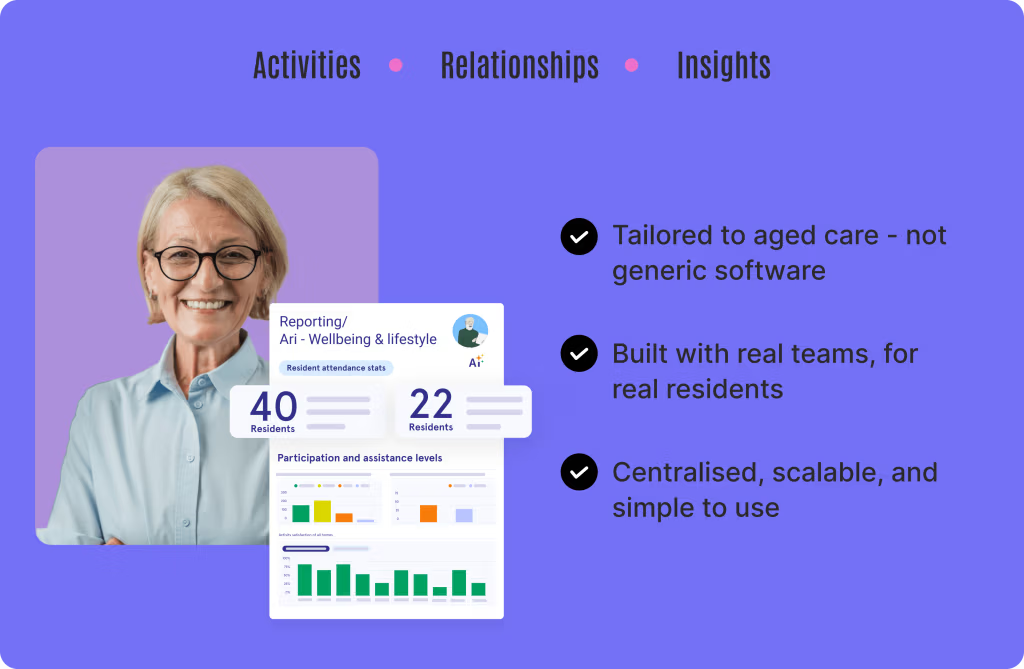
This is what the Carepage Activity and Resident Intelligence module is built around: HELF tracking that connects directly to resident feedback, complaints, and quality reporting in one place, rather than requiring staff to bridge the gap manually.
What to ask before choosing a HELF platform
Before committing to any software for HELF management, these are the questions worth putting to every vendor:
Can it produce a resident-level HELF evidence report for a specific date range? If the answer involves exporting to Excel and doing it manually, that’s a problem.
Does it track opt-in and opt-out history with timestamps? Not just current status. History.
How does it connect to complaints and feedback? If a resident complains about a HELF service, can you see that complaint alongside the delivery record for that service?
Can it link HELF delivery data to your NQIP reporting? Under the National Quality Indicator Program, experience and quality of life indicators are directly relevant to how well your HELF program is landing. A platform that reports on HELF independently of your NQIP data is making your quality team do duplicate work.
What does the audit trail look like? Ask to see an actual example of what a compliance report looks like. Not a demo. A real output from a real provider.
How Carepage approaches HELF management
Carepage is built for aged care providers who need to treat HELF as part of a wider quality and experience function rather than a standalone billing tool.
The platform connects HELF agreement tracking and service delivery logging with resident feedback, family feedback, complaints management, and NQIP reporting. When a resident’s HELF satisfaction score drops, their quality coordinator sees it in the same dashboard as their service delivery records. When a complaint comes in about a HELF service, it’s logged against that resident’s full care and experience history.
For providers running lifestyle and activity programs, the activity and resident intelligence module handles HELF program management as part of broader lifestyle coordination. Rather than running a separate HELF system alongside an activity system alongside a feedback platform, everything sits in one place.
If you want to see what this looks like in practice, book a demo. We’ll walk through the HELF compliance setup specifically.
The bottom line
HELF management software needs to do more than track packages and process billing. It needs to create an evidence trail that holds up under a formal assessment, connect delivery records to resident experience, and reduce the manual workload on coordinators who are already stretched.
The providers who will benefit most from HELF over the next 12 to 24 months are the ones who treat it as a resident experience commitment backed by data, not an administrative process to be managed in isolation.
Choosing the right software is how you make that possible.
For more on the regulatory context behind HELF, the Australian Government Department of Health’s HELF fact sheet is the primary reference. For a legal breakdown of provider obligations, Hall and Wilcox have published a detailed HELF analysis worth reading alongside your compliance team.
Book a demo of Carepage — see the HELF management module in action.